
Chicken Merge

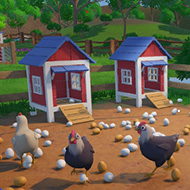
Chicky Farm

Grow Up The Cats

MECCHA CHAMELEON
PetBox: Ultimate Desktop Pet

Deer Simulator
Eggstreme Farming


















You tap the feeder until it overflows with hay, and a line of hungry hens rushes over to peck at it before waddling off toward their nesting spots. A few seconds later the first egg lands in the Stored Egg panel, and your thumb is already back on the feeder for another round. That loop, repeated dozens of times a minute, is the entire heartbeat of Chicky Farm, and it stays satisfying far longer than it has any right to.
The core loop never really changes: fill the Feeder, let the chickens eat, then tap each finished egg before it piles up. Early sessions revolve around a single Feedbox, and every egg you collect goes straight into Gold, the currency that drives every other system in the game. Chickens don’t lay on a fixed timer you can predict from a menu — you learn their rhythm by watching them, which is part of why the game feels more hands-on than a typical idle title.
New players usually make the same mistake: they let the Feedbox sit empty while grinding through menus, not realizing that an idle hen is a hen producing nothing. Keeping the feeder topped off matters more than any single upgrade early on, since Gold income is capped by how many chickens are actively eating and laying at once.
Spend enough Gold and the Barn becomes the first real investment worth planning around. Upgrading the Barn raises its level and unlocks more room for chickens and storage, which matters because a full coop with nowhere to put new birds is a common early bottleneck. Barn upgrades don’t scale cheaply, so most players save toward one big jump rather than trickling Gold into smaller purchases.
Once the Barn is a few levels deep, the pace of the game shifts. You’re no longer just tapping — you’re deciding whether the next chunk of Gold goes toward more birds, a Speed boost, or a Worker.
Workers are where Chicky Farm quietly turns into a management sim. Hiring a Worker means part of the feeding-and-collecting loop keeps running without your input, and each Worker can be upgraded up to its own maximum level before you need to bring in another one. Alongside Workers sits the Speed stat, a separate upgrade track that makes both chickens and hired help move through their tasks faster.
Balancing Workers against Speed is one of the few genuine decisions the game asks of you. Some players funnel everything into Speed to maximize taps-per-minute; others stack Workers so the farm keeps earning Gold while the game is closed.
The Shop is where accumulated Gold turns into permanent progress: more chickens, Barn upgrades, and Worker slots all pass through it. Beyond pure numbers, Chicky Farm also lets you reskin the look of your farm, which has no effect on income but gives long-term players something to work toward once the upgrade math stops feeling urgent. It’s a small touch, but it’s the reason people who’ve long since maxed their early Workers keep coming back.
Egg output in Chicky Farm is tied to how many chickens are actively fed and how far you’ve pushed the Speed stat, not to a hidden timer. If the Feedbox keeps running dry, chickens sit idle instead of laying, so refilling it consistently does more for your Gold rate than most single upgrades.
Neither is objectively correct, but Workers pay off if you check in on the farm infrequently, since a maxed Worker keeps collecting eggs while you’re away. Speed helps more if you’re actively tapping, because it shortens the gap between feeding the flock and having new eggs ready to sell for Gold.
Barn upgrades raise its level and open up more room for chickens and stored eggs, which removes the bottleneck of a coop that’s full but still producing. It’s the upgrade most players save toward first, since a low-level Barn caps how big the rest of the farm can grow.
Chicky Farm never asks for much strategic depth, and it doesn’t pretend to — the appeal is in the rhythm of feeding, collecting, and watching Gold turn into a bigger Barn and a longer line of hired Workers. Once you’ve pushed past the first few upgrade tiers, the game settles into a comfortable loop where the only real decision left is whether to spend Gold on capacity or on customizing the farm you’ve built.