

Chicken Merge

Chicky Farm

Grow Up The Cats

MECCHA CHAMELEON
PetBox: Ultimate Desktop Pet

Deer Simulator
Eggstreme Farming






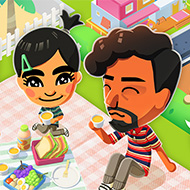










In Tomodachi Life 2 you start with a single unlocked district, Bop City, a handful of blank character slots, and no quest marker telling you what to do next. There is no combat tutorial, no timer, and no fail state waiting around the corner — just a stretch of buildings you can already walk into and a Character Creator sitting empty until you decide who lives here. That starting condition matters more than it sounds, because everything you experience afterward branches out from those first few rooms rather than from any written storyline.
Bop City ties together eight separate buildings — an apartment block, a theater, a clothing store, a supermarket, a beauty salon, a food alley, a garbage dump, and a post office — and roughly 39 characters wander between them at any given time. Ten Crumpets are tucked into corners and behind furniture across the district, and finding all of them is the kind of quiet side goal that keeps players circling back to buildings they think they’ve already searched.
Early on, most players just open doors to see what’s inside rather than following any plan, and that’s by design. Nothing punishes wandering, and nothing rewards rushing either, which is part of why Bop City works as a starting point rather than a level to clear.
Once you move past the starting area, the map opens into more specialized districts. Pom Pom Peaks is a snow-covered winter district ringed by mountains, with six locations and around 53 characters living inside it, while Vox Valley adds five more locations, close to 57 characters, and five additional Crumpets to track down. Lettuce Lands takes the pace in a different direction entirely — a farmers’ town built around vegetable fields, wheat fields, a farmhouse, and a barn, closer to a slow-life setting than the neon energy of Bop City.
Across the full map there are around 15 districts, more than 90 individual locations, and over 500 characters in total, which is part of why players rarely describe finishing the game — there’s simply always another building nobody’s opened yet.
By the time you reach Pom Pom Peaks, the pattern becomes obvious: each district has its own visual identity and its own small cast, and moving a character from one district’s apartment into another district’s shop is a completely normal way to play.
Every district comes pre-populated with named residents, but the Character Creator is where most of the actual roleplay starts. Players build original characters piece by piece — face, hair, outfit, accessories — and then drop them into whichever building fits the story they’re telling that day. Pre-made characters and Character Creator characters exist side by side with no mechanical difference between them once they’re placed in the world.
Because there’s no assigned goal, most of what happens in Tomodachi Life 2 is players assigning themselves one. A short list of the roles people commonly build stories around:
One thing that comes up constantly in reviews and forum threads is that a meaningful chunk of the newer districts and location packs sit behind Toca Cash rather than something earned through play, which means two players can have very different amounts of map available to them depending on what they’ve bought — a point of real friction for a game built around open-ended exploration.
None of this is presented as a race to finish, and that’s the point — Tomodachi Life 2 keeps working as long as there’s an empty apartment in Bop City or an unopened door in Pom Pom Peaks left to fill with a story nobody’s told yet.