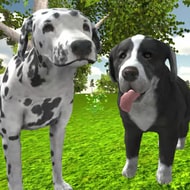
In Dog Simulator 3D you start on the open island as a single, ownerless dog with an empty dog house, no mate, and a health bar and energy bar that are both full. Everything else — territory, a family, a decorated home — has to be earned from that starting point, one quest and one hunt at a time.
Starting Out in Dog Simulator 3D
The first stretch of Dog Simulator 3D is about learning the island rather than chasing any single goal. Movement is simple — WASD or the arrow keys to run, Space to jump, Shift to sprint — but the open layout means new players spend their first few minutes just following the minimap toward whichever quest marker is closest. Villages, forest patches, and open fields all sit on the same island, and nothing stops a low-level dog from wandering into an area that’s clearly meant for later.
Beginners tend to underestimate how much sprinting costs. Holding Shift burns through the energy bar quickly, and a dog that runs out of energy mid-chase is left slow and vulnerable exactly when a threat shows up.
Energy, Hunger, and the Health Bar
Energy and health are the two numbers that actually decide how a session goes. Energy drops while sprinting and refills on its own while walking or standing still, but the fastest way to top it back up is to eat — food scattered around the island restores it directly. Health only drops in combat, and letting it run out mid-fight against something like a wild boar ends the encounter fast.
Because the two bars interact, players who sprint everywhere tend to walk into fights already low on energy, which is one of the more common ways a run in the game goes wrong early on.
Family Life and the Dog House in Dog Simulator 3D
Once a dog has leveled up enough through quests and points, it can find a mate and start a family — the core loop the game is built around. Puppies join the family over time and can be raised alongside the original dog, and the family unit becomes part of how later content plays out rather than just a cosmetic milestone.
The dog house sits at the center of that family life. It can be decorated with items earned through play, and a lot of returning players treat customizing it, and picking new skins for their dog, as its own goal separate from the quest list.
- Skins and breed options for the dog itself
- Decorative items for the dog house
- Cosmetic upgrades unlocked through points earned from quests and hunting
Defending the Village from Wild Boars
Combat in Dog Simulator 3D isn’t constant, but it shows up in specific, recognizable moments — the clearest being village defense, where wild boars push into a settlement and the player has to fight them off before they do damage. It’s a small enough encounter that a well-fed, high-energy dog handles it easily, but the same fight against a boar can go badly if a player wandered in already low on health.
These fights are also where the point system pays off directly: points earned from quests and hunting go into upgrading the dog’s attributes, and a dog that’s been leveled up feels noticeably tankier in these boar encounters than one that’s been left at its starting stats.
Long-time players generally agree the loop is easy to pick up in the first few minutes, even if the amount of side content thins out compared to how open the island initially looks.
- How do you get a family in Dog Simulator 3D? Leveling up through quests and points lets a dog find a mate; puppies then join the family and grow alongside the original dog, becoming part of the dog house setup rather than a one-time unlock.
- Why does my dog run out of energy so fast in Dog Simulator 3D? Sprinting with Shift drains the energy bar quickly; it regenerates while walking, but eating food found around the island restores it faster than resting alone.
- What happens when wild boars attack the village in Dog Simulator 3D? It triggers a direct combat encounter — the dog has to fight the boars off using its health bar and whatever attributes have already been upgraded through points, so going in with low energy or health makes the fight harder than it needs to be.
Dog Simulator 3D works because none of its systems exist in isolation — the energy bar decides how safely a player can approach a boar fight, the point system decides how strong the family ends up, and the dog house is where all of that progress becomes visible. Starting from one dog with an empty house and ending with a full family and a decorated home is still the throughline that keeps players coming back to it.